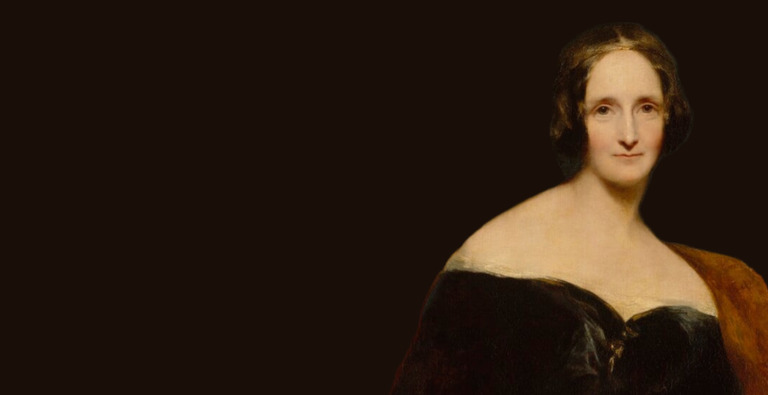

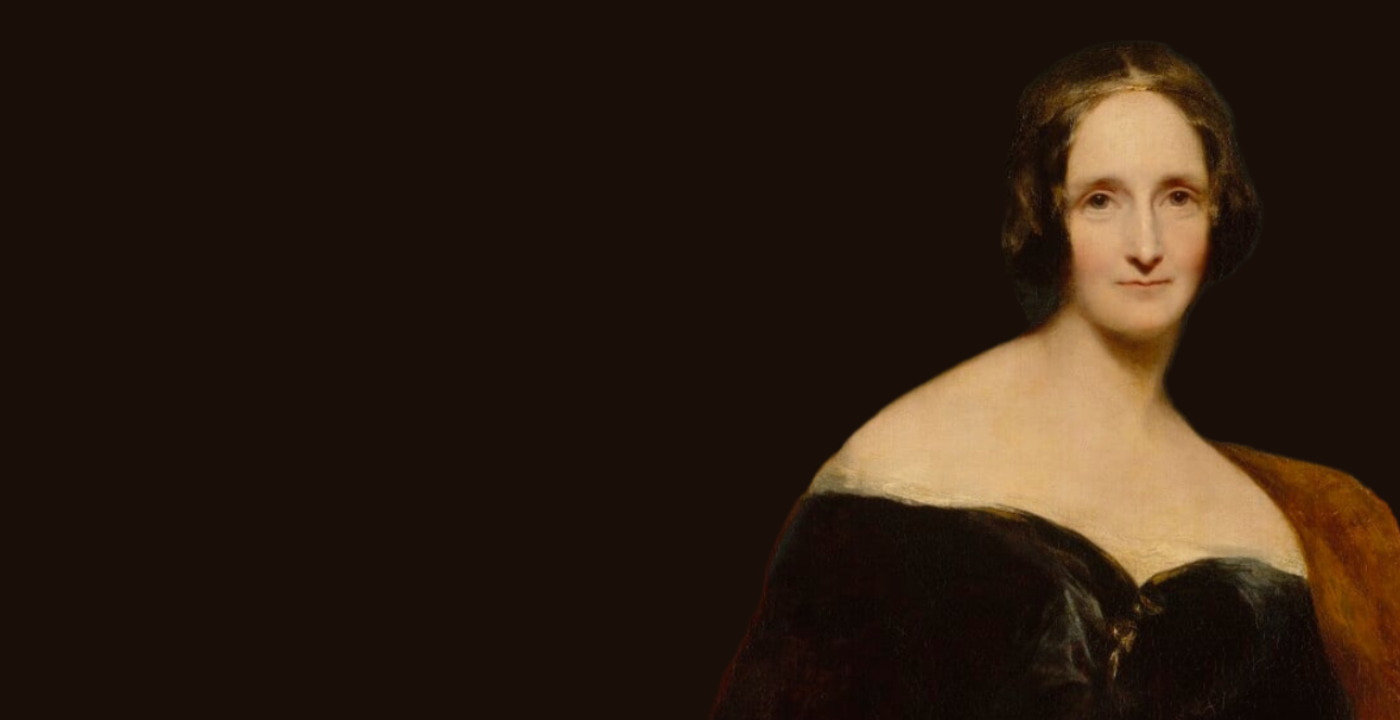
Birth
August 30th, 1797 in The Polygon, London SW4, UKDeath
February 1st, 1851 in Chester Square, London SW1W, UKMary Wollstonecraft Shelley was an English author best known for her novel Frankenstein (1818).
Personal Information
Name(s) Mary Wollstonecraft Shelley (Née Mary Wollstonecraft Godwin).
Date and place of birth: August 30, 1797. The Polygon, Somers Town, London, England.
Date and place of death: Died from a brain tumor on February 1, 1851. 24 Chester Square, London, England.
Family
Mother: Mary Wollstonecraft (1759–1797), later Godwin. Feminist philosopher and writer. Author of A Vindication of the Rights of Woman (1792) and The Wrongs of Woman: or, Maria (1798).
Father: William Godwin (1756–1836). Philosophical anarchist, radical political writer, historian, and novelist. His most famous work is An Enquiry Concerning Political Justice (1793). With Caleb Williams (1794) and St Leon (1799), he originated the political Gothic novel.
Marriage and Family Life
Shelley never knew her mother. Eleven days after her birth, Wollstonecraft had died of puerperal fever. She grew up with two half-siblings, an uncongenial stepmother, and two step-siblings. Her half-sister, Fanny (1794–1816), was Wollstonecraft’s daughter by Gilbert Imlay, an American. Godwin adopted her and gave her his name. Her half-brother, William (1803–1832), was Godwin's son by his second wife. In 1801, the widowed Godwin had married Mary Jane de Vial (1768–1841), a self-proclaimed widow calling herself Mrs. Clairmont, a capable businesswoman. She had two illegitimate children: Charles (1795–1850) and Jane, later known as Claire Clairmont (1798–1879). In 1805, Godwin and Mary Jane founded a children’s bookshop, the Juvenile Library. It sold titles written, translated, and commissioned by the two of them. This enterprise kept the perpetually debt-ridden family afloat. Mary Jane resented Godwin’s evident estimate of Mary as the cleverest of the five and compensated by favoring Claire. The rivalry between Mary and Claire was lifelong. Mary sought substitute sisters in intimate friendships with other women (Isabella Baxter, Jane Williams, Frances Wright). These relationships were usually disappointing, involving rejection and betrayal, or else failed to develop. In Italy, she enjoyed a quasi-daughterly relationship with Maria Gisborne (1770–1836), to whom Godwin had once proposed.
At the age of sixteen, Mary met Percy Bysshe Shelley (1792–1822), a married poet and heir to a baronetcy, five years her senior and estranged from his wife, Harriet. A disciple of William Godwin, he offered the philosopher financial support. Mary and Percy fell madly in love and eloped to Switzerland on July 28, 1814, taking Claire with them. The furious Godwin refused to receive the couple on their return but continued to demand money from Percy. In 1815, Percy negotiated a regular private income from his hostile father, sufficient to support the lifestyle of a gentleman, though not an opulent or spendthrift one. He could afford to employ nursemaids and servants, releasing Mary from domestic drudgery and providing time for study and writing. So far, so fortunate, for a woman of her era with a desire to be both a writer and a mother. But her life was laced with tragedy. Fanny Godwin and Percy’s wife, Harriet, both committed suicide in 1816, leaving legacies of guilt. (Following Harriet’s suicide, at the insistence of the Godwins, Mary and Percy married in December 1816.) The loss of three of their children left deep scars. Mary’s first baby, a girl (b. and d. 1815), died a cot death. The other two, Clara (1817–1818) and William (1816–1819) died in Italy, to which the Shelleys had moved in 1818. Only the youngest, Percy Florence (1819–1889), lived to adulthood. Her life with Percy was not easy. They were intellectual companions and collaborators, with similar political views, but temperamentally different. He was impulsive and emotionally inconstant, forming intense attachments to other women, one of whom was Claire, with whom he may or may not have had an actual affair. His accidental drowning in July 1822 was the greatest sorrow of Mary’s life. She was only twenty-four, but never remarried.
Education (short version)
Home-schooled, private tutors, private boarding school
Education (longer version)
Shelley received an education befitting an intellectual and woman of letters, but she was also taught the skills of household economy and some polite female accomplishments (housekeeping, basic accounts, needlework, dancing, French). She was largely home-schooled, but briefly attended a private girls’ boarding school for Dissenters at Ramsgate in 1811. Her parents’ educational theories were influenced by Rousseau. They believed that children’s natural curiosity and desire to learn would motivate them to seek knowledge without coercion, but they rejected Rousseau’s insistence that girls and boys should have different educational curricula. Shelley had a quick and retentive memory, and her study habits were regular, disciplined, and systematic. Godwin described her at fifteen as “singularly bold, somewhat imperious, and active of mind.” At sixteen, she had fluent reading of French, enough Latin to read some Cicero, and was well-read in history, mythology, biography, geography, and literature. She extended her knowledge of languages. and, over the course of her life, acquired Italian, Spanish, Portuguese, some German, and classical Greek, a study that she enjoyed.
Religion
Shelley had no religious affiliation. She has been called a “Romantic deist.” Her parents came from a background of Rational Dissent. Godwin, an atheist who had rejected the beliefs of his strict Calvinist upbringing, encouraged free thought in the young but discouraged them from scoffing at religion. Her opinions were at first markedly aligned with Percy’s, who had been expelled from Oxford for authoring The Necessity of Atheism. During his lifetime, she was a skeptic and attracted to Spinozan pantheism. Like Percy, she adhered to the ethics of Socrates and Jesus Christ regarding toleration and non-retribution. After Percy’s death, while continuing to reject all religious dogma, including the creed of rewards and punishments in an afterlife, she cherished the hope of being reunited with him in some form of immortality.
Transformation(s)
Shelley's constant reading and rereading of her parents’ works determined the kind of writer she would become. Wollstonecraft’s influence is evident in her travel writing and landscape descriptions, as well as in the recurrent theme of maternal absence in her novels. Her fictional mothers tend to be glorified, lost, or dead. William Godwin’s work also resonates throughout her work, stylistically and thematically. It is present in the father-daughter relationships of Mathilda (1819), Lodore (1835), and Falkner (1837); like Godwin, she wrote both tales of terror and historical novels. If she had not eloped with Percy Shelley, she would undoubtedly have had a writing career, perhaps beginning as an author in Godwin’s Juvenile Library. In 1807, she wrote verses, or perhaps a piece in prose, adapted for Mounseer Nongtongpaw, a Juvenile Library title. But she would not have become the author of Frankenstein.
The elopement was a turning point. Percy encouraged Mary’s ambitions, urging her to learn Greek and to seek fame through authorship. Her reading became more adventurous (the dark, violent Gothic novel The Monk, the subversive works of Voltaire). But it was Claire Clairmont’s unexpected 1816 liaison with Byron that brought about the Shelleys’ meeting in Geneva that summer with the most celebrated poet of the age. The momentous consequences of their association with Byron include the ghost story challenge that resulted in Frankenstein and, indirectly, the Shelleys’ move to Italy in 1818. Domineering, quasi-Byronic, sometimes fascinating male figures stalk through Mary’s fiction—characters whose pride, selfishness, and desire for power conflict with political justice and the domestic affections; they are often contrasted with gentle, sensitive, chivalrous men, physically frail but morally strong, idealizations of Percy.
After Percy’s death, Mary returned to England, intent on ensuring the lasting fame of her husband and on supporting herself and their son by writing. She ultimately succeeded in both aims, though her father-in-law, Sir Timothy Shelley, forbade her to bring the Shelley name to public notice and gave her, in compensation, an allowance only just sufficient to keep her precariously on the fringes of gentility. The 1820s and 1830s were her most prolific decades. She published fiction, drama, journal reviews, and biographies. Under the sobriquet “The Author of ‘Frankenstein,’” she was a major contributor of short tales in the Keepsake, one of the most famous of the annual literary gift-books that flourished during those decades. Sir Timothy’s ban was slightly relaxed, and she earned enough to afford two visits to Europe in the early 1840s. Her 1839 editions of Percy’s poetry and prose are a landmark in the nineteenth-century history of women’s editorship of literary remains. Her last published book was Rambles in Germany and Italy (1844). Her son’s succession to the Shelley baronetcy in 1844 brought financial security, and his marriage brought her happiness. Her last five years were marked by a painful progressive illness, a final split with Claire, and the devotion of her son and her daughter-in-law. She is buried in Bournemouth with them, her parents, and Percy Bysshe Shelley’s heart.
Contemporaneous Network(s)
Shelley was, from childhood, accustomed to meeting eminent persons. Godwin had a large network of friends and acquaintances that included scientists (Humphry Davy), writers and philosophers (Coleridge, Elizabeth Inchbald, Charles Lamb, Amelia Opie, Charlotte Smith), politicians (Aaron Burr, John Philpot Curran), actors, and artists. She is known to have been introduced to some of them.
Later, through Percy, she became a friend of the campaigning journalist and poet Leigh Hunt, editor of the radical newspaper, the Examiner. In Italy, she was drawn into proximity to Byron and his circle and, on several occasions, transcribed press copies of his poems. In Pisa, she met a group of Greek patriotic exiles, one of whom, Prince Alexandros Mavrocordatos, tutored her in Greek, joined the Greek War of Independence in 1821, and later became Prime Minister of Greece. She contributed to the short-lived Liberal (1822–23), a journal founded by Byron, Hunt, and Shelley.
In the 1830s and 1840s, Shelley’s paths intersected with those of many literary and political figures, but she was not an insider in any circle. Her literary acquaintances of these decades include William Hazlitt, Mary Lamb, Prosper Mérimée, Benjamin Constant, Thomas Moore, Caroline Norton, Lady Morgan, and Benjamin Disraeli. She was on cordial terms with the editors of the journals to which she contributed, but her association with Shelley ensured that she never published with John Murray, the era’s most prestigious publisher. If she had had the money, she might have traveled more and strengthened her literary friendships in London and Paris.
less
Significance
Works/Agency
Shelley’s most famous work is Frankenstein (1818). Her novella Mathilda (1819) is a tale of a father's incestuous desire for his daughter, his remorse and suicide, and her irrational guilt and despair. Valperga (1823) is ostensibly a historico-political romance set in medieval Tuscany. It explores issues such as the potential of female power and the persistence of the idea of democracy throughout the upheavals of history. The Last Man (1826) is a dystopian novel set in the future, in which plague exterminates the human race, except for one man.
For a fuller list of Shelley’s oeuvre, please view the Bibliography section.
Reputation
Frankenstein was widely reviewed. It was highly praised by Walter Scott for its originality and style, but vituperated by sections of the press. The author’s gender and identity soon became known, provoking amazement, outrage, and admiration, though not incredulity. (It seemed just the kind of novel that a daughter of Wollstonecraft and Godwin might be expected to write.) The first French translation appeared in 1821. Frankenstein was not a best-seller, but in 1823 it was adapted for the stage, and a second edition was issued. In 1831, it was republished in a cheaper one-volume edition, revised and enlarged by Shelley, with her famous introduction detailing the novel’s genesis. Mathilda was not published until 1959. Godwin, disturbed by its transgressive theme, had opposed publication. Valperga received mostly bland commendation for its depiction of medieval life, and its originality was overlooked by almost every reviewer. It is still the most underrated of Shelley’s novels. The Last Man (1826) was execrated as a gloomy train of horrors. Her later, more mainstream novels, Perkin Warbeck (1830), Lodore (1835), and Falkner, pleased the public more, but are distinctively unusual examples of the genres of the historical novel, the “silver fork” novel of high life, and the novel of domestic manners.
In the 1830s, by then known as “Mrs. Shelley,” she was numbered among the leading contemporary British women novelists. Her fiction was not universally praised, but it was considered remarkable and often commended for its combination of powerful concepts and psychological acuity; her novels and Keepsake tales were pirated in America. Her short biographies in Lardner’s Cabinet Cyclopaedia (1835–39) contributed to the 1830s “March of Mind,” the widening of access to all branches of knowledge among those excluded from higher education by class, gender, and money. Although not a public intellectual, she participated obliquely in public discourse. Throughout her career, she steadfastly argued for Italian fitness for independence, anticipating Elizabeth Barrett Browning. Rambles reveals her as a reflective observer of the cultural and political scene during the period leading up to the 1848 Year of Revolution.
With the emergence in the 1840s of Dickens, Elizabeth Gaskell, the Brontës, and George Eliot, most novelists of the 1820s and 1830s fell out of fashion, Shelley among them. After her death, she was best remembered for editing her husband’s works, though the widespread idea that her own works disappeared completely from the public eye is a fallacy. Lodore, Perkin Warbeck, and Frankenstein were reprinted, the last in several cheap editions. The many scattered Victorian references to Frankenstein, including one in Dickens’s Great Expectations (1861), show that the novel had entered the language. The scientist and his Creature had, like Hamlet, Don Quixote, Faust, and Don Juan, escaped from the printed page and authorial control, roaming the world. An upsurge of interest in Shelley herself during the 1880s and 1890s saw the first biographies, a collection of her tales, and the beginnings of her global reputation, with Frankenstein being translated into Japanese. But that tide receded. In the twentieth century, the cultural image and worldwide reach of Frankenstein were furthered by the 1931 film adaptation starring Boris Karloff and numerous subsequent interpretations, but apart from her notes to Percy’s poems (and Frankenstein itself), her writings had long been out of print.
Legacy and Influence
First attempts to reclaim Shelley as a serious and important author were pioneered between 1951 and 1969. By the early 1970s, Frankenstein was becoming recognized as a woman-centered novel. A major reclamation and reappraisal by feminist literary critics, led by Ellen Moers (1976), merged with contemporary critical revalorizations of the literary gothic and science fiction. Shelley was regarded as the “mother of science fiction” (1973) on the strength of both Frankenstein and The Last Man. Reliable editions of her letters and journals, and a major full-length biography, were published during the 1980s. Between 1976 and 2002, almost all her writings, including unpublished manuscripts, were issued in scholarly editions. Monographs and essays offered influential interpretations of her novel: critiques of male Romantic Prometheanism and/or patriarchy, or of fictionalized autobiography; they contextualized her novels within contemporary radical science or the constraints facing female authors. Essay collections, beginning with The Other Mary Shelley (1993), raised awareness of her writings beyond Frankenstein. Mathilda, with its daring exploration of a taboo subject, and The Last Man attracted special attention. In the twenty-first century, Shelley's reputation has continued to grow, particularly since the bicentenary of Frankenstein in 2018. Her work has been examined from the perspectives of ecological and disability studies, imperialism, and enslavement; there is now a tendency to regard Shelley as a collaborator. The Last Man speaks powerfully to fears of human extinction in the age of COVID, climate change, and world instability. The idea that she was a one-book author persists—unjustly, but it is true that none of her other works has the iconic status of Frankenstein. The novel endures as a powerhouse in the 21st century, inspiring an unending proliferation of interpretations across diverse media and global iconography. By inventing the scientific gothic and the futuristic dystopian novel, Mary Shelley expanded the bounds of cultural imagination. She inaugurated a cross-media category that transcends the tangible, while remaining firmly rooted in the themes of contemporary life.
less
Controversies
How much of a feminist was Shelley? She once admitted in a soul-searching journal entry that she lacked the temperament for public polemics or activism, but affirmed that her private conduct manifested her unwavering adherence to her mother’s principles: “[I]f I have never written to vindicate the Rights of women, I have ever befriended women when oppressed—at every risk I have defended and supported social victims” (MWS Journals II, 557).
The discovery (1974) that Percy had made corrections and alterations to the surviving Frankenstein rough draft prompted a suggestion that he should be regarded as her co-author, and a countercharge that he had imposed an ornate style on her more direct and colloquial one. Charles E. Robinson’s detailed examinations (1996, 2015) discovered that Mary adjusted her style to make her draft less colloquial as she progressed. He concluded that Percy’s changes (often very minor) are editorial, not authorial, and that Mary exercised her agency in choosing to accept or reject his interventions.
Which Frankenstein text is best? The first (1818) or the third (1831)? Or is each equally good in its own way? The 1818 text is frequently preferred as the bolder, punchier version; defenders of 1831 contend that the differences in content are not major and that her revisions improved plotting and gave greater prominence to philosophical issues such as free will versus necessity.
less
Clusters & Search Terms
Current Identification(s)
Novelists, gothic writers, travel writers
Clusters
Female writers, 19th-century writers
Search Terms
Mary Shelley, Gothic Literature, Percy Bysshe Shelley, Frankenstein, 19th century
References in existing schemas
less
Bibliography
Primary (selected):
Fiction: Novels and Novellas
Frankenstein: Or, The Modern Prometheus. 3 vols. Lackington, Hughes, Harding, Mavor, & Jones, 1818. 2 vols. G. and W. B. Whittaker, 1823. 1 vol. Colburn & Bentley, 1831. Mathilda (1819). Pub. 1959.
Valperga: Or, The Life and Adventures of Castruccio, Prince of Lucca. 3 vols. G. and W. B. Whittaker, 1823.
The Last Man. 3 vols. Henry Colburn, 1826.
The Fortunes of Perkin Warbeck, A Romance. 3 vols. Henry Colburn and Richard Bentley, 1830. Lodore. 3 vols. Richard Bentley, 1835.
Falkner. A Novel. 3 vols. Saunders and Otley, 1837.
Short Fiction
“Maurice; or, The Fisher’s Cot.” 1820. Pub. 1998.
“Valerius: The Reanimated Roman.” c.1819. Fragment. Pub. 1976.
“An Eighteenth-century Tale.” c. 1819. Fragment. Pub. 1976.
“A Tale of the Passions.” Liberal. 2 (1823): 289–325.
“The Bride of Modern Italy.” London Magazine. 9 (1824): 351–63.
“The Heir of Mondolfo.” c.1825–27. Appleton’s Journal. ns. 2 (1877): 12–23.
“Roger Dodsworth: The Reanimated Englishman.” 1826. Pub. 1863.
“The Sisters of Albano”; “Ferdinando Eboli.” Keepsake for 1828 (1827): 80–100; 195–218. “The Mourner”; “The Evil Eye”; “The False Rhyme.” Keepsake for 1829 (1828): 71–97; 150–75; 265–68.
“The Swiss Peasant”; “Transformation.” Keepsake for 1830 (1829): 121–46; 18–39. “The Dream, A Tale.” Keepsake for 1831 (1830): 22–38.
“The Brother and Sister, An Italian Story.”; “The Invisible Girl.” Keepsake for 1833 (1832): 105–41; 210–27.
“The Mortal Immortal. A Tale.” Keepsake for 1834 (1833): 71–87.
“The Smuggler and his Family.” Original Compositions in Prose and Verse. Edmund Lloyd, 1834. 27–53.
“The Trial of Love.” Keepsake for 1835 (1834): 70–86.
“The Elder Son.” Heath’s Book of Beauty. 1835 (1834): 83–123.
“The Parvenue.” Keepsake for 1837 (1836): 209–21.
“The Pilgrims.” Keepsake for 1838 (1837): 128–55.
“Euphrasia: A Tale of Greece.” Keepsake for 1839 (1838): 135–52.
Drama
“Proserpine, A Mythological Drama in Two Acts.” 1820. Winter’s Wreath (1831): 1–20. “Midas.” 1820. Pub. 1922.
Travel Writing
History of a Six Weeks’ Tour through a Part of France, Switzerland, Germany, and Holland: with Letters Descriptive of a Sail round the Lake of Geneva, and of the Glaciers of Chamouni. [With Percy Blysshe Shelley] T. Hookham Jun. and C. and J. Ollier, 1817. Rambles in Germany and Italy in 1840, 1842, and 1843. 2 vols. Moxon, 1844.
Biography
“Madame D’Houtetôt.” Liberal. 2 (1823): 67–83.
“Memoir of Shelley.” 1823. MS. fragment. Pub. 1997.
“Memoirs of William Godwin.” Introd. Caleb Williams by William Godwin. Colburn and Bentley, 1831. iii–xiii.
Biographies in Lardner’s Cabinet Cyclopaedia: Eminent Literary and Scientific Men of Italy, Spain, and Portugal. 3 vols. Eminent Literary and Scientific Men of France. 2 vols. Longman, Orme, Brown, Green, & Longman, and John Taylor. 1835–39. (All but seven by Shelley.) “Life of William Godwin” 1836–c.1840. MS. Fragment. Pub. 1999.
Journalism: Articles
“Giovanni Villani.” Liberal. 4 (1823): 281–97.
“Recollections of Italy.” London Magazine. 9 (1824): 21–26.
“On Ghosts.” London Magazine. 9 (1824): 253–56.
“A Visit to Brighton.” London Magazine. 16 (1826): 460–66.
Journalism: Reviews
The English in Italy, by Lord Normanby; Continental Adventures. [by Charlotte Eaton]; Diary of an Ennuyée, [by Anna Jameson]. Westminster Review. 6 (1826): 325–41. “Defence of Velluti.” Examiner. 958 (11 June 1826): 372–73.
La Guzla, ou Choix de Poésies Illyriques and La Jaquerie; Feudal Scenes, [by Prosper Mérimée]. Westminster Review. 10 (1829): 71–81.
Italy as It Is, by H. D. Beste and A Tour in Italy and Sicily by L. Simond. Westminster Review. 11 (1829): 127–40.
The Loves of the Poets, [by Anna Jameson]. Westminster Review. 11 (1829): 472–77. Cloudesley; a Tale, by William Godwin. Blackwood’s Edinburgh Magazine. 27 (1830): 711–16. 1572. Chronique du Temps de Charles IX, [by Prosper Mérimée]. Westminster Review. 13 (1830): 495–502.
Journal of a Tour in Italy, by James P. Cobbett. Westminster Review. 14 (1831): 174–80. The Bravo; a Venetian Story, [by James Fenimore Cooper]. Westminster Review. 16 (1832): 180–92.
“Modern Italian Romances.” Monthly Chronicle. (November 1838): 415–28; (December 1838): 547–57.
Translations (selected)
“The Story of Psyche in the Golden Ass of Apuleius.” From the Latin. 1817. MS. fragment. Pub. 2002.
“Relation of the Death of the Family of the Cenci.” From the Italian. 1819. Pub. 1840, Shelley also translated from French, Spanish, and German.
Poetry
Shelley wrote about twenty poems, of which the longest and most important is “The Choice” (1823). Seven were published in The Keepsake between 1830 and 1838, including “A Dirge,” which she considered to be her best.
Editions of other authors
Posthumous Poems of Percy Bysshe Shelley. Ed. and introd. by Mary W. Shelley. John and Henry L. Hunt, 1824.
The Poetical Works of Percy Bysshe Shelley. Ed. and introd. with notes by Mrs. Shelley. 4 vols. Edward Moxon, 1839; 2nd ed., 1 vol. 1839.
Essays, Letters from Abroad, Translations and Fragments, by Percy Bysshe Shelley. Introd. and ed. Mrs. Shelley. 2 vols. Edward Moxon, 1839; 2nd ed., 1 vol. 1845.
Archival Resources (selected):
Bodleian Library MSS. Shelley and MSS. Abinger (including Frankenstein MS., journals, letters, notebooks).
Carl H. Pforzheimer Collection of Shelley and His Circle, New York Public Library (literary MSS, letters).
Huntington Library, San Marino, CA (letters).
Morgan Library and Museum, New York.
Library of Congress, Washington, DC (journal) .
Keats–Shelley House, Rome.
Luther Brewer Collection, Library of the University of Iowa (notebook).
Web Resources (selected):
https://knarf.english.upenn.edu; fully annotated online Frankenstein. 1818 and 1831 eds., with ancillary reading.
https://shelleygodwinarchive.org/contents/frankenstein/; https://
shelleygodwinarchive.org/contents/ms_abinger_d33/. Page images with transcripts of MSS of Frankenstein and Mathilda.
less
Photos


Publication date: Mar 10, 2026
Last updated: Mar 10, 2026
Comment
Your message was sent successfully