Rethinking women's mobility and social networks in prehistoric Europe
More than 3,300 years ago, a young woman was buried in a monumental mound in what is now Denmark. Carefully laid to rest in an oak coffin and dressed in a distinctive outfit, she remained hidden beneath the earth for millennia. When archaeologists uncovered the burial in 1921 near the village of Egtved in Jutland, they could not have imagined that this young woman would eventually transform our understanding of mobility and women’s lives in Bronze Age Europe.
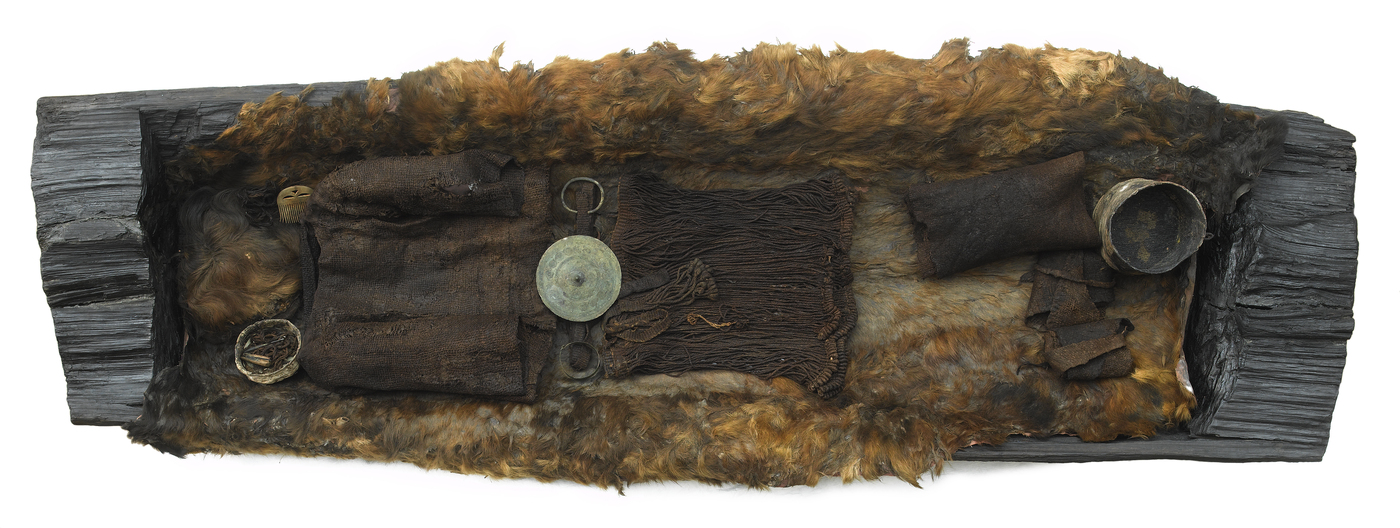
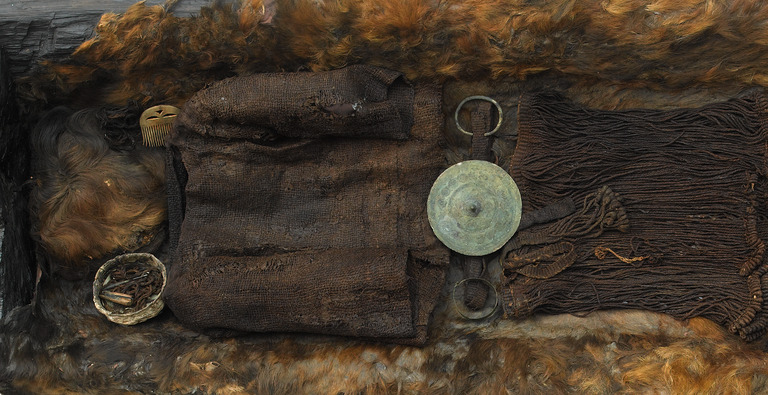
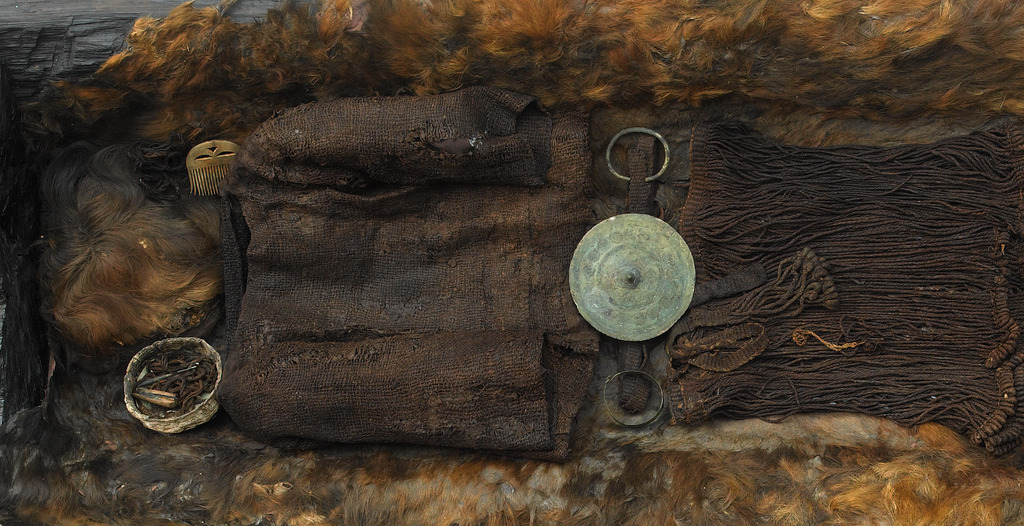
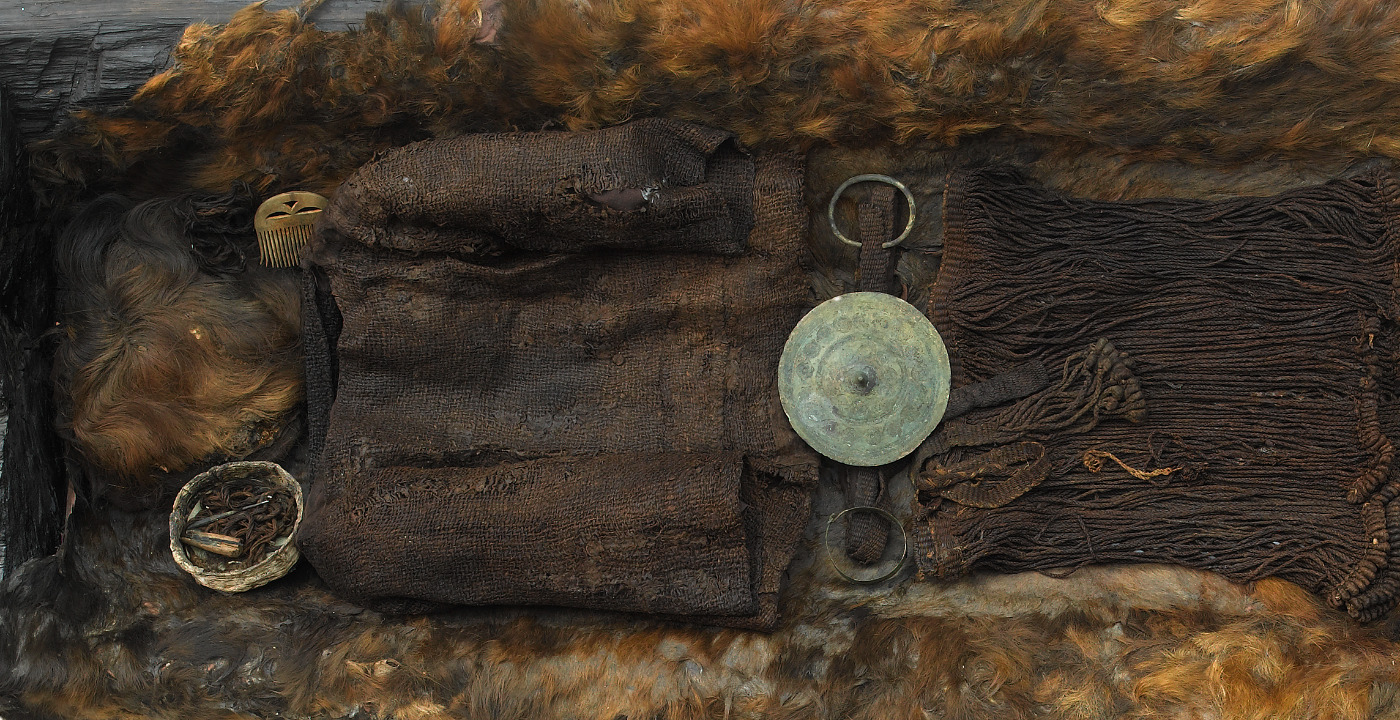
The remains of the high-status Bronze Age female known as the Egtved Girl. Her garments are exceptionally well preserved and include a finely crafted wool costume and a disc-shaped bronze belt symbolising the sun. (Photo: Roberto Fortuna and Kira Ursem, National Museum of Denmark).
Today, the individual known as the Egtved Girl—who lived during the Nordic Bronze Age (c. 1700–500 BCE)—is one of the most famous elite female burials in Europe. More than a century after her discovery, she continues to play a central role in archaeological and scientific studies of prehistoric life. She has also become one of the most iconic figures in Denmark’s prehistory and is a symbol of the Bronze Age communities that once inhabited southern Scandinavia.
Part of what makes the Egtved Girl—perhaps more accurately described as a young woman, since she was between sixteen and eighteen years old when she died—so fascinating today is her appearance. The design of her clothing, despite being more than 3,300 years old, appears strikingly modern to contemporary eyes. The burial itself was remarkably well preserved upon its 1921 discovery near the village of Egtved, from which she takes her modern name.
We do not know her real name, nor can we identify her family or social identity through written sources, since none exist from Scandinavia during this period. Archaeology, however, can still tell us much about her life. The circumstances of her burial indicate that she belonged to the social elite of her time. She was placed at the center of a burial mound, a monumental construction requiring substantial labor and coordination. Such mounds were typically built for individuals of high status within Bronze Age society.
Since her discovery, the Egtved Girl has become a representative of the Nordic Bronze Age and of women’s presence and significance in the distant past of southern Scandinavia. Her clothing and burial equipment have inspired many interpretations. She wore a distinctive outfit consisting of a short corded skirt, a blouse, and a large bronze belt plate decorated with spirals. Because similar outfits appear on certain Bronze Age figurines and spiral motifs are often associated with solar symbolism in Bronze Age art, some researchers have interpreted her as a possible priestess connected to sun worship—an important symbolic system during the Bronze Age.
For nearly a century after her discovery, scholars assumed that the Egtved Girl was local to the region where she was buried. Numerous studies were conducted on the burial throughout the twentieth century, yet none questioned the assumption that she was local. This interpretation reflected broader theories about mobility during the European Bronze Age. Archaeologists long believed that most people lived relatively local lives and rarely traveled far from where they were born. Long-distance movement was thought to be limited and typically associated with men—especially warriors, traders, or chieftains maintaining exchange networks between distant communities.
Women, in contrast, were rarely considered active travelers. When women appeared—based on their archaeological context—to have distant origins, scholars often interpreted them as having moved only once in their lives, usually through marriage alliances linking powerful families or chieftains. In this model, women’s mobility was seen as limited and largely determined by political arrangements assumed to have been made by male leaders.
The shift in how we understand women’s mobility—and its implications for their roles in Bronze Age societies—was initiated by the publication of new scientific analyses of the Egtved Girl in 2015. Our study used strontium isotope analysis to investigate the remains of the Egtved Girl, the child buried with her, and wool threads from her clothing. Strontium isotopes provide a powerful tool for studying human mobility in the past. Different geological regions have distinct isotope signatures that enter the food chain through soil, plants, and water. These signatures become incorporated into human tissues such as teeth, bones, nails, and hair. Tooth enamel forms during childhood and does not change afterward, preserving a biogeochemical record of the environment where a person grew up. Hair and fingernails grow continuously and reflect the final months of life.
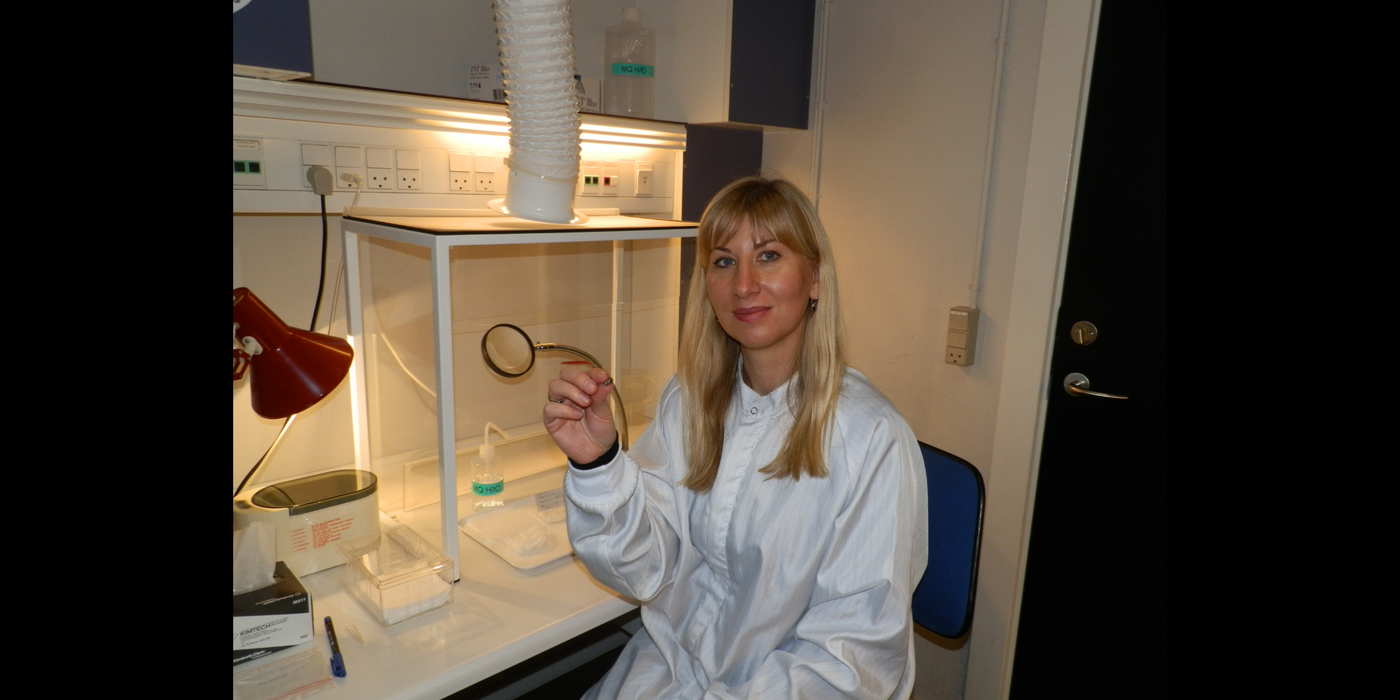
Professor Karin Margarita Frei holds the Egtved Girl's tooth enamel. A small fragment was sampled for strontium isotope analysis to investigate where she spent her early life. (Photo: Cristina Nora Jensen, University of Copenhagen).
The strontium isotope signature in the Egtved Girl’s first molar—which reflects her early childhood—did not match the local baseline values from the Egtved region. This discovery suggested she had grown up somewhere else.
Further analyses revealed something even more remarkable. Isotopic signatures preserved in the Egtved Girl’s hair and fingernails showed that she had moved between regions with different geological signatures several times during the last years of her life. In other words, she had not simply migrated once; she appears to have traveled repeatedly across different landscapes.
These results transformed our understanding of the Egtved Girl. She was not a local individual but someone who had come from elsewhere—most likely from a region south of present-day Denmark. Possible areas include parts of southern Germany, although regions such as southern Sweden cannot be entirely excluded.
Through these investigations, the Egtved Girl became the first Bronze Age woman in Europe to be identified as a traveler through isotopic analysis. Her story challenged long-standing assumptions about female mobility and social roles in prehistoric societies, and opened new perspectives on the ways women may have contributed to the movement of ideas, practices, and knowledge across Bronze Age Europe.
Since the publication of these findings, similar studies have identified other non-local women across Bronze Age Europe. In some regions, including the Lech Valley in southern Germany, research shows that women were often the individuals who moved between communities while men tended to remain local. These discoveries suggest that female mobility may have played a far more significant role in maintaining social networks and cultural connections than previously recognized.
In recent years, a few researchers questioned the suitability of one of the environmental baselines used to interpret the Egtved Girl’s data in the 2015 study, particularly whether modern water samples provide the most reliable reference for ancient mobility. To address this issue, a 2026 study proposed an alternative approach.
Instead of relying solely on environmental samples—such as surface water, soils, or plants—we constructed a statistically robust reference range using more than 600 strontium isotope measurements from archaeological human remains excavated in present-day Denmark. This dataset, the first of its kind for the region, provides a stronger framework for understanding regional variation in strontium isotope values in prehistoric Denmark.
The results strongly support the original interpretation. They confirm that neither the Egtved Girl nor the child buried with her had local origins in the Egtved region. Both individuals likely came from elsewhere, reinforcing the conclusion that she traveled significant distances during her life.
Therefore, the Egtved Girl continues to reshape our understanding of Bronze Age societies.
Her story challenges older views that imagined prehistoric women as largely stationary figures confined to their home communities. Instead, the Egtved Girl reveals a world in which women moved across regions, maintained connections between distant places, and were even honored with elite burials in communities where they did not originate.
Today, the Egtved Girl stands as more than an archaeological discovery. She represents how new scientific approaches—from isotope analysis to large comparative datasets—can reshape our understanding of the past. Perhaps most importantly, she reminds us that women were not simply passive figures in these worlds. They were participants in the networks, journeys, and exchanges that shaped Bronze Age Europe.
Bibliography:
Frei et al., (2015) https://www.nature.com/articles/srep10431
Knipper et al., (2017) https://www.nature.com/articles/d41586-017-03221-x
Thomsen and Andreasen, (2019) https://www.science.org/doi/10.1126/sciadv.aav8083
Frei et al., (2026) https://journals.plos.org/plosone/article?id=10.1371/journal.pone.0341434
Karin Margarita Frei is the first Professor of Archaeometry in Denmark. She holds a PhD in Archaeometry and an MSc in Geology/Geochemistry from the University of Copenhagen. Her research has pioneered the development of strontium isotope tracing methodologies used to investigate the provenance of raw materials in ancient textiles and to study ancient human mobility, making it possible to reconstruct past journeys and life histories with unprecedented detail, including through the analysis of cremated human remains. Frei has been a pioneer in the study of individual female mobility during the European Bronze Age and has initiated and led major research initiatives, including the Tales of Bronze Age Women project funded by the Carlsberg Foundation.
After many years dedicated to uncovering the journeys of women in the past, she stepped away from her full professorship at the National Museum of Denmark in 2025 to follow a new calling. Following two periods of burnout, she chose to redirect her work toward supporting highly driven individuals—particularly women—who experience high levels of stress or find themselves in moments of inner transition. Today she works as a reflective advisor and lifestyle coach, helping others cultivate what she calls inner coherence: living a passionate and sustainable life in alignment with both the nervous system and the heart. In many ways, her work continues to explore the idea of journeys—now focusing on the inner journeys that shape our lives today. She is also a writer and painter.