


Birth
C. 1753, in West Africa, possibly in Senegal or Gambia
Death
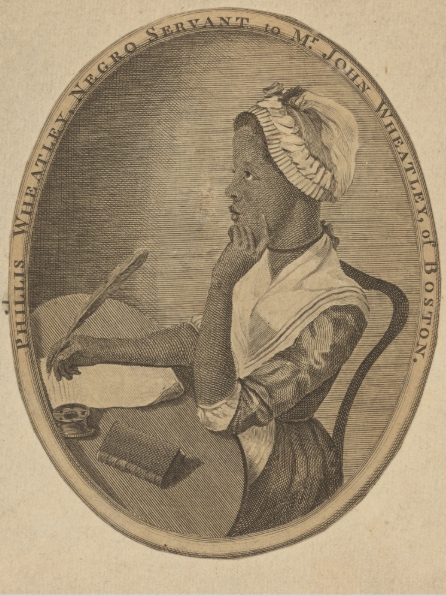
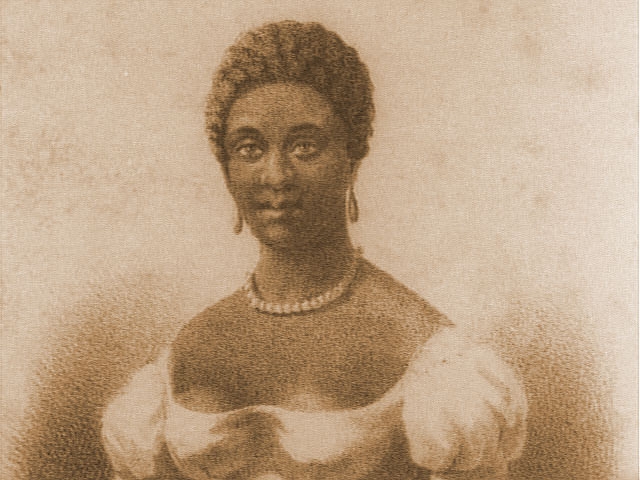
December 5th, 1784 in Boston, MA, USAPhillis Wheatley Peters was an American Revolutionary-era writer best known for her groundbreaking book, Poems on Various Subjects, Religious and Moral (1773). As an enslaved woman and the first African American to publish a book of poetry, Wheatley gained international fame. Her poetry, which explored grief, enslavement, Evangelism, the Revolutionary War, classical literature, and mythology, also served as an impetus for the emerging Abolitionist movement.
New Historia schema reviewed by Charita Gainey, Ph.D., author of the dissertation "'Strange Longings': Phillis Wheatley and the African American Literary Imagination," Harvard University (2017).
Personal Information
Name(s)
Phillis Wheatley, Phillis Wheatley Peters, Phillis Peters
Date and place of birth
1753 in West Africa, possibly in Senegal or Gambia.1
Date and place of death
December 5, 1784, in Boston, Massachusetts.
Family
Mother: Unknown
Father: Unknown
Marriage and Family Life
It is unknown if Phillis Wheatley had siblings before being trafficked and brought to America. Some accounts, based on Margaretta Odell’s original claims, state that Wheatley had three children with her husband, John Peters, though this has not been confirmed by recent scholarship.2
Phillis Wheatley and John Peters (c. 1746-1801) were married by Reverend Lathrop on November 26, 1778, at the Second Congregational Church in Boston. Peters was a free Black man. The couple lived together on Queen Street before their marriage, a choice which followed the death of Wheatley’s enslaver, John Wheatley.3 After being wed, the name “Phillis Peters” was used in a 1779 book proposal and her letters.4 Peters was a grocer with a moral reputation that varies across historical recoveries and interpretations. For instance, historian Henry Louis Gates Jr. posits that a Wheatley relative recalled Peters as courteous.5 However, activist and essayist Hannah Mather Crocker relayed a contradictory account of Peters’ character, writing, “She [Phillis Wheatley] married at twenty one a man of noteriety by the name of Peters, he did not treat her will. She soon fell a prey, to disapointment and her keen sensibility proved a sudden decline and she died [sic].”6 Some scholars have also, perhaps incorrectly, said that John Peters abandoned Wheatley and moved to the American South. Recent interpretations have questioned the validity of this long-held claim, originally asserted by Margaretta Matilda Odell, a white woman and alleged descendant of Susanna Wheatley. Professor Honorée Fanonne Jeffers argues that Odell’s portrayal is false. Public records may support Professor Jeffers’ view that Peters remained in Boston and did not relocate to the South, as Odell claimed. In her book The Age of Phillis (2020), Professor Jeffers wrote, “Maybe he hadn’t abandoned her. Maybe Odell had misrepresented their relationship."7
Education (short version)
Phillis Wheatley received a comprehensive education in literature, religious texts, and multiple languages from the Wheatley family.
Education (longer version)
Phillis Wheatley received an impressive education from the Wheatley family. Mary Wheatley, the daughter of Susannah and John Wheatley, taught Phillis to read. She demonstrated a powerful intellect. Within only sixteen months of arriving in America, Wheatley could read texts across genres—including the Bible, Latin, Greek, and English literature.8 Phillis Wheatley’s poetry demonstrates the cultural breadth of her education, including her knowledge of Greek Mythology. For instance, Wheatley references Tithon, Aurora, and Mount Helicon in her piece “On Imagination.” 9
Religion
Christian. Phillis Wheatley was baptized as a Congregationalist at Boston’s Old South Church on August 18, 1771. She was approximately age 18. Interestingly, the Wheatleys were members of the New South Church. Perhaps Phillis Wheatley’s choice demonstrated determination and autonomy, diverging from the church that her Susannah and John frequented.10 Phillis Wheatley used poetry to reveal her religious beliefs, condemning the hypocrisy of Christians who enslaved and dehumanized Black people.11 Wheatley’s poem “On Being Brought from Africa to America” (published 1773) confronts Christians directly. Wheatley writes that those of “sable race” who white people view “with scornful eye,” “May be refin'd, and join th' angelic train.” 12 In this poem, Wheatley also uses the term “black as Cain” as a descriptor, referencing the white American assumption that Black people were descendants of the Biblical Cain. Since God marked Cain for his sins, there was a disturbing belief that those with Black ancestry were “subordinate” to those of European lineage.13 Wheatley defies this false presumption of Biblical inequality in her poem, depicting the “angelic train” (or entrance into heaven) as accessible despite one’s race.
less
Significance
Works/Agency
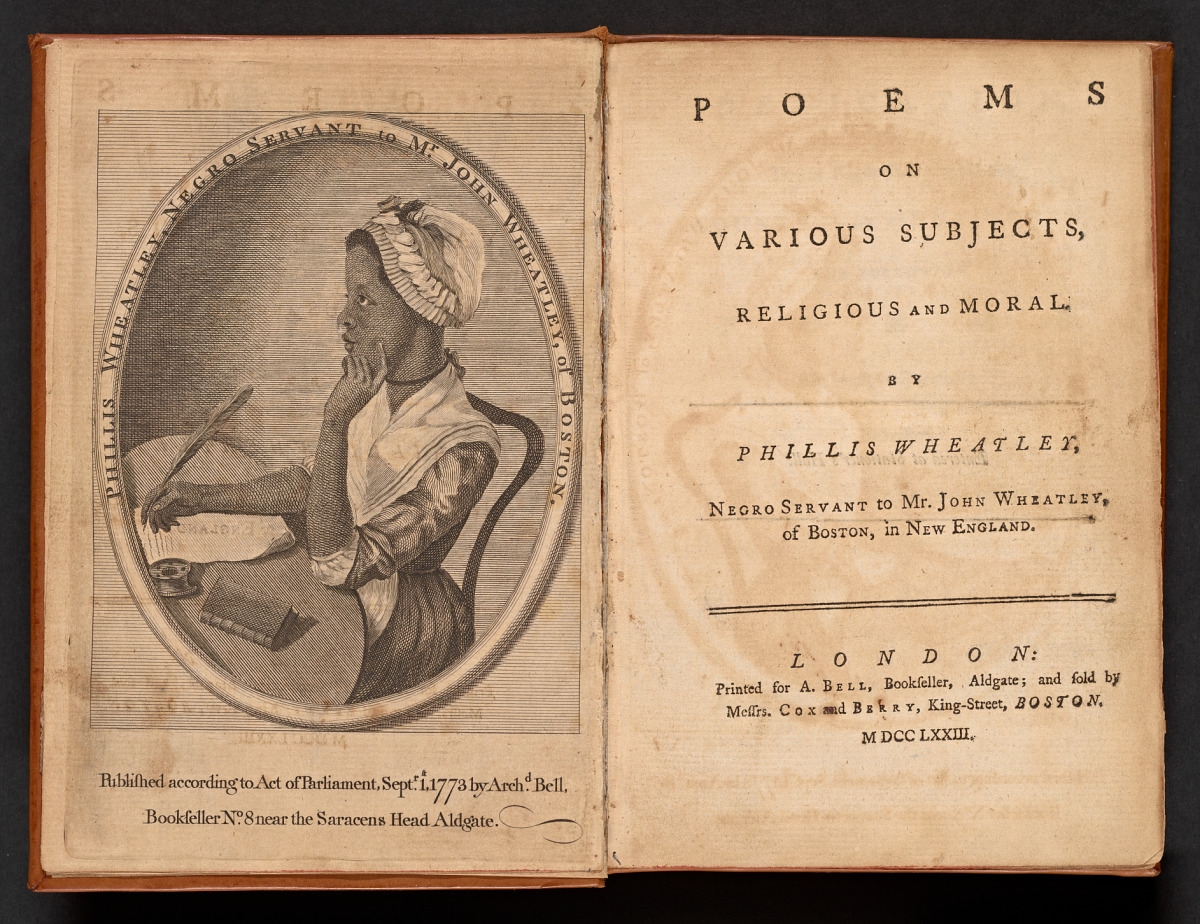
Phillis Wheatley became a published poet at only thirteen years of age, when her 1767 piece “On Messrs. Hussey and Coffin” was circulated in the Newport Mercury Newspaper. It was a mournful tribute to a prominent Evangelist, however, which sparked Wheatley’s global fame. Wheatley’s piece “A Funeral Elegy, On The Revd, and Renowned George Whitefield” (September 1770), is a paramount example of bereavement-as-theme within Wheatley’s work. Pieces memorializing the deceased, whether friends or strangers, make up over one-third of Wheatley’s poetry. Wheatley’s only book, Poems on Various Subjects, Religious and Moral, was first distributed in 1773 by London publisher A. Bell and contained 39 poems, frequently in couplet form. 20
To verify the book’s legitimacy, it was signed by a list of Boston men, including John Hancock and John Wheatley. Wheatley’s book explores a range of themes and contexts, including enslavement (“On Being Brought from Africa to America“), Christian teachings (“Thoughts on the Work of Providence”), elegies (“On the Death of a young Lady of Five Years of Age), and political commentary (“To the King’s Most Excellent Majesty).” 21
Wheatley drew inspiration from Classical and Neoclassical literature. Wheatley’s poem “Liberty and Peace,” for instance, employs the heroic couplet to chronicle the American Revolutionary War—a distinct stylistic choice associated with Neoclassical writers such as Alexander Pope. Her piece, “Niobe in Distress for Her Children Slain by Apollo, from Ovid’s Metamorphoses, Book VI, and from a view of the Painting of Mr. Richard Wilson,” translates and reconceptualizes the Ovidian classic by giving Niobe a newfound agency, where her prideful transgressions are a defiance against the injustices she experiences.22
Reputation
“The lines from Miss Phillis (to be sure she is Miss now) are very extraordinary & ’tis indeed wonderful that Genius tho’ uncultivated shou’d shine amidst slavery & distress,” wrote William Steele (1715-85), father of poet Mary Steele.23 Wheatley’s reputation as a literary trailblazer and the first African American published poet has been both celebrated and derided. Her intellect as an enslaved woman piqued international interest during a time of severe racism and prejudice. Some viewed her as a novelty, while others posited that she was evidence of prodigious Black intellect. While several public figures, such as George Washington, sang her praises, others insulted and discredited her poetry and character. Thomas Jefferson notoriously wrote, “Religion, indeed, has produced a Phillis Whately [sic]; but could not produce a poet. The compositions under her name are below the dignity of criticism.”24
Wheatley did not die celebrating her deserved laurels. After the release and initial interest in Poems on Various Subjects, Wheatley faded from the public eye. She became destitute, worked at a boarding house, and was buried in an unmarked grave upon her death. Posthumously, Wheatley’s reputation has fluctuated. According to Henry Louis Gates Jr., she was praised as “an icon of black intellectual perfectibility by the abolitionist movement” through the 1840s and 50s. Criticism of Wheatley arose, however, during the 20th century: she was described as an “imitation” of Alexander Pope in the 1920s, “oblivious to the lot of fellow blacks” during the Civil Rights movement, and “too white” in the 1970s.25 Others have interpreted Wheatley’s work as vapid or plain due to her love of couplets. However, the 1970s and 80s also brought revived respect for Wheatley. According to David Waldstreicher, new archival discoveries and a 1973 Phillis Wheatley Poetry Festival at Jackson State University (attended by figures such as June Jordan and Audre Lorde) helped rejuvenate Wheatley’s reputation as a poetic icon. Modern scholarship continues to decode Wheatley’s life through a more autonomous lens: “She may still be a timeless allegory for the white society,” writes Waldstreicher, “but she is now a conscious, crafty one.” 26
Legacy and Influence
Scholar Molefi Kete Asante listed Phillis Wheatley as one of the “100 Greatest African Americans” in 2002. In 2003, the Boston Women’s Memorial placed a public statue of Wheatley alongside Abigail Adams and Lucy Stone. Wheatley’s church, Old South in Boston, holds an annual “Phillis Wheatley Sunday” in her memory, with a promenade to the Boston Women’s Memorial after the service. To celebrate 250 years of Wheatley’s legacy, institutions such as the University of Wisconsin-Madison (2023), the National Museum of African American History and Culture (2025), and the American Library in Paris (2025) held exhibitions and programming in her honor.
An abundance of schools, university buildings, and community centers across the U.S. are named after Wheatley, ranging from New York City to Texas. For instance, the Phillis Wheatley Center in Minneapolis, MN, recently celebrated its 100th anniversary, providing programs and support to the local Black community. Phillis Wheatley/Wheatley-Peters Hall at The University of Massachusetts Boston is named in honor of the poet. Among numerous other “Phillis Wheatley” scholarships, the Phillis Wheatley YWCA in Washington, DC, hosts a college scholarship program for local graduating seniors.
less
Controversies
As a Black female prodigy in the 18th century, Wheatley challenged preconceived racist notions. By referencing ancient Egyptian bondage, Wheatley created controversy among white Americans who solely equated Blackness with enslavement, contradicting attempts to “normalize” slavery as a permanent, modern American institution.
Posthumously, Wheatley remains a controversial figure in Black history. Some readers and scholars argue that her poetry adhered to the “white savior” narrative. For example, some interpret the opening lines of “On Being Brought from America to Africa” as Wheatley seeming grateful for her kidnapping and enslavement: “Twas mercy brought me from my Pagan land,/Taught my benighted soul to understand/That there's a God, that there's a Saviour too.” Cofounder of the Black Arts Movement, Amiri Baraka, maintained this stance, stating that Wheatley had “Uncle Tom syndrome… She is pious, grateful, retiring, and civil." 27 Furthermore, by exalting enslavers like George Washington in her poetry, readers may believe Wheatley wrote to appease the morals and sentiments of white readers. Recent scholarship has worked to reconsider and redefine Wheatley’s intentions. Perhaps her poetry was more strategic, coded, and discreet in expressing anti-slavery notions. To survive and continue working in an overwhelmingly white-male-dominated literary field, Wheatley possibly had to incorporate subtle language and double meanings into her poetry. “No more, America, in mournful strain / Of wrongs, and grievance unredress’d complain, / No longer shalt thou dread the iron chain,” wrote Wheatley in a poem to the Earl of Dartmouth, describing her hopes for America’s future as a personified concept, but perhaps also a desire to be unshackled from slavery..28
New and Unfolding Information and/or Interpretations
In 2023, UAlbany professor Wendy Raphael Roberts discovered Wheatley’s earliest full elegy. Penned in 1767, “On Death of Love and Rotch” was found by Roberts in a Pennsylvania commonplace book. Though Wheatley did not confirm the piece’s legitimacy, she was given credit by a reliable witness within her circle.29
New interpretations have arisen regarding the trajectory of Wheatley’s life, diverting from preexisting narratives. The written accounts of Margaretta Matilda Odell, an alleged descendant of Susanna Wheatley, have long been held as truth. Odell problematically portrayed Wheatley’s kidnapping and enslavement as a positive “rescue” from West Africa, according to writer Elizabeth Winkler. According to Odell’s assertions, it was only after Wheatley’s enslavers died that she allegedly fell into poverty, bleakness, and the arms of a villainized free Black man. Writer Honorée Fanonne Jeffers reframed the context of Wheatley’s life, relationships, and work in her 2020 book The Age of Phillis. Deriving from years of research, Jeffers questions and debunks Odell’s claims. There is no concrete genealogical proof of Odell’s relationship to Susannah Wheatley. Public census documents may also discredit claims of John Peter’s abandonment of Phillis Wheatley, which Jeffers reveals in her book.30
less
Footnotes
1. Vincent Carretta, Phillis Wheatley: Biography of a Genius in Bondage (Athens, GA: The University of Georgia Press, 2011).
2. Henry Louis Gates Jr., The Trials of Phillis Wheatley: A1merica’s First Black Poet and Her Encounters with the Founding Fathers (New York, NY: Basic Civitas Books, 2003).
3. Carretta, Phillis Wheatley: Biography of a Genius in Bondage.
4. Elizabeth Winkler, “How Phillis Wheatley Was Recovered through History,” The New Yorker, July 30, 2020, https://www.newyorker.com/books/under-review/how-phillis-wheatley-was-recovered-through-history.
5. Gates, The Trials of Phillis Wheatley.
6. Carretta, Phillis Wheatley: Biography of a Genius in Bondage.
7. Winkler, “How Phillis Wheatley Was Recovered through History."
8. Gates, The Trials of Phillis Wheatley.
9. Wheatley, Phillis, “On Imagination” in Poems on Various Subjects, Religious and Moral. [London: Printed for A. Bell, bookseller, Aldgate and sold by Messrs. Cox and Berry ... Boston, MDCCLXXIII, 1773]. Library of Congress, Rare Books and Special Collections Division. https://www.loc.gov/item/30020911/.
10. Carretta, Phillis Wheatley: Biography of a Genius in Bondage.
11. Catherine Adams and Elizabeth H. Pleck, Love of Freedom: Black Women in Colonial and Revolutionary New England (Oxford: Oxford University Press, 2010).
12. Wheatley, Phillis, “On Being Brought from Africa to America” in Poems on Various Subjects, Religious and Moral. [London: Printed for A. Bell, bookseller, Aldgate and sold by Messrs. Cox and Berry ... Boston, MDCCLXXIII, 1773]. Library of Congress, Rare Books and Special Collections Division. https://www.loc.gov/item/30020911/.
13. “Phillis Wheatley | Jamestown-Yorktown Foundation, VA,” Jamestown-Yorktown Foundation Museums, https://www.jyfmuseums.org/learn/research-and-collections/essays/phillis-wheatley.
14. Wheatley, Phillis, “To the Right Honorable William, Earl of Dartmouth” in Poems on Various Subjects, Religious and Moral. [London: Printed for A. Bell, bookseller, Aldgate and sold by Messrs. Cox and Berry ... Boston, MDCCLXXIII, 1773]. Library of Congress, Rare Books and Special Collections Division. https://www.loc.gov/item/30020911/.
15. Carretta, Phillis Wheatley: Biography of a Genius in Bondage.
16. “Phillis Wheatley | Jamestown-Yorktown Foundation, VA,” Jamestown-Yorktown Foundation Museums.
17. Phillis Wheatley to Obour Tanner (Boston, MA: Massachusetts Historical Society Collections Online, October 30, 1773).https://www.masshist.org/database/774
18. Carretta, Phillis Wheatley: Biography of a Genius in Bondage, 116.
19. Gates, The Trials of Phillis Wheatley.
20. “Phillis Wheatley Peters.” Poetry Foundation. https://www.poetryfoundation.org/poets/phillis-wheatley.
21. Wheatley, Phillis, Poems on Various Subjects, Religious and Moral. [London: Printed for A. Bell, bookseller, Aldgate and sold by Messrs. Cox and Berry ... Boston, MDCCLXXIII, 1773]. Library of Congress, Rare Books and Special Collections Division. https://www.loc.gov/item/30020911/.
22. Spigner, Nicole A, "Chapter 11 Phillis Wheatley’s Niobean Poetics". In Brill’s Companion to Classics in the Early Americas, (Leiden, The Netherlands: Brill, 2021) doi: https://doi.org/10.1163/9789004468658_013
23. Timothy Whelan, gen. ed., Nonconformist Women Writers, 1720-1840, 8 vols (London: Pickering & Chatto, 2011), 3.239.
24. David Waldstreicher, The Odyssey of Phillis Wheatley: A Poet’s Journeys Through American Slavery and Independence (New York, NY: Picador / Farrar, Straus and Giroux, 2024).
25. Gates, The Trials of Phillis Wheatley, 74.
26. Waldstreicher, The Odyssey of Phillis Wheatley.
27. Gates, The Trials of Phillis Wheatley, 76.
28. Wheatley, Phillis, “To the Right Honorable William, Earl of Dartmouth” in Poems on Various Subjects, Religious and Moral. [London: Printed for A. Bell, bookseller, Aldgate and sold by Messrs. Cox and Berry ... Boston, MDCCLXXIII, 1773]. Library of Congress, Rare Books and Special Collections Division. https://www.loc.gov/item/30020911/.
29. Bethany Bump, “Ualbany Professor Finds New Poem by Famed Early American Poet Phillis Wheatley,” University at Albany, 2023.
30. Winkler, “How Phillis Wheatley Was Recovered through History."
less
Bibliography
Sources
Primary (selected):
Secondary:
Adams, Catherine, and Elizabeth H. Pleck. Love of Freedom: Black Women in Colonial and Revolutionary New England. Oxford: Oxford University Press, 2010.
Carretta, Vincent. Phillis Wheatley: Biography of a Genius in Bondage. Athens, GA: The University of Georgia Press, 2011.
Gates, Henry Louis. The Trials of Phillis Wheatley: America’s First Black Poet and Her
Encounters with the Founding Fathers. New York, NY: Basic Civitas Books, 2003.Meyers, Julia M. “Liberty and Peace by Phillis Wheatley: EBSCO.” EBSCO Information Services, Inc. | www.ebsco.com, 2022. https://www.ebsco.com/research-starters/history/liberty-and-peace-phillis-wheatley.
Spigner, Nicole A. "Chapter 11 Phillis Wheatley’s Niobean Poetics". In Brill’s Companion to Classics in the Early Americas, (Leiden, The Netherlands: Brill, 2021) doi: https://doi.org/10.1163/9789004468658_013
Waldstreicher, David. The Odyssey of Phillis Wheatley: A Poet’s Journeys Through American Slavery and Independence. New York, NY: Picador / Farrar, Straus and Giroux, 2024.
Archival Resources (selected):
Wheatley, Phillis. Letter to Obour Tanner. Boston, MA: Massachusetts Historical Society Collections Online, October 30, 1773. https://www.masshist.org/database/774
Wheatley, Phillis. Letter to Obour Tanner. Boston, MA: Massachusetts Historical Society Collections Online, March 21, 1774. https://www.masshist.org/database/775
Wheatley, Phillis. Poems on Various Subjects, Religious and Moral. [London: Printed for A. Bell, bookseller, Aldgate and sold by Messrs. Cox and Berry ... Boston, MDCCLXXIII, 1773] Jefferson Exhibit Collection, and John Davis Batchelder Collection. Library of Congress, Rare Book and Special Collections Division. https://www.loc.gov/item/30020911/.
Web Resources (selected):
Bump, Bethany. “UAlbany Professor Finds New Poem by Famed Early American Poet Phillis Wheatley.” University at Albany, 2023. https://www.albany.edu/news-center/news/2023-ualbany-professor-finds-new-poem-famed-early-american-poet-phillis-wheatley.
“Phillis Wheatley | Jamestown-Yorktown Foundation, VA.” Jamestown-Yorktown Foundation Museums. https://www.jyfmuseums.org/learn/research-and-collections/essays/ phillis-wheatley.
“Phillis Wheatley Peters.” Poetry Foundation. https://www.poetryfoundation.org/poets/phillis-wheatley.
Winkler, Elizabeth. “How Phillis Wheatley Was Recovered through History.” The New Yorker, July 30, 2020. https://www.newyorker.com/books/under-review /how-phillis- wheatley-was -recovered-through-history.
less
Films
Photos
Publication date: May 27, 2026
Last updated: Aug 6, 2026
Comment
Your message was sent successfully