


Birth
1840
Death
1876
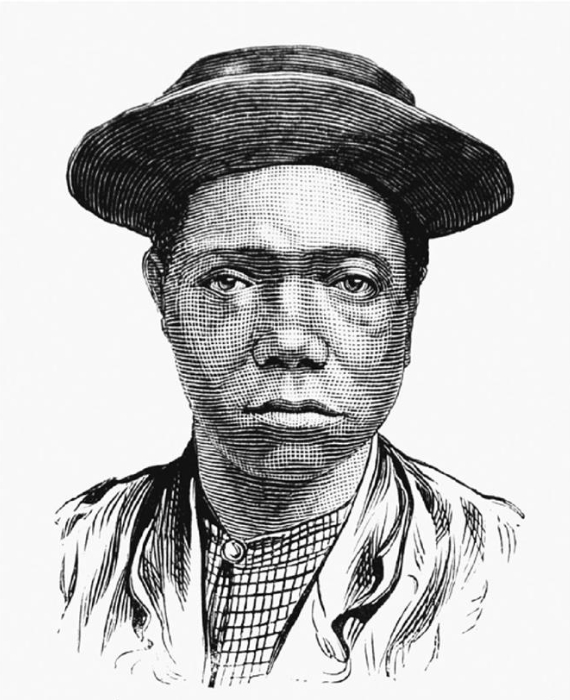
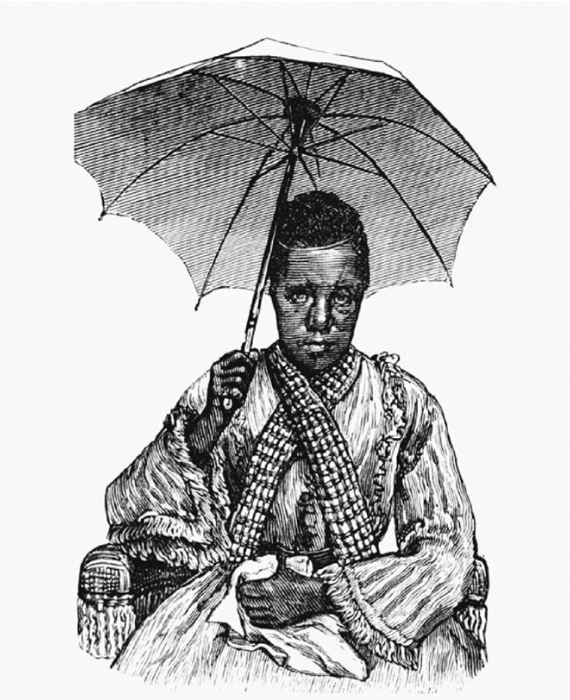
Frances Thompson, an Alabama-born, Maryland-raised, formerly enslaved woman, became the first Black transgender woman to testify in front of the U.S. Supreme Court.
Personal Information
Date and place of birth
1840, Alabama
Date and place of death
1876, North Memphis, Tennessee.
Transformation(s)
Frances Thompson was born into slavery in Alabama in 1840. She grew up in Maryland before her enslavement by Virginia-born Robert Walker. Although assigned male at birth, the Walkers and others recognized Thompson as a woman. She was allowed to keep her face clean-shaven and wear feminine clothing. Frances was disabled since childhood, suffering from what she described as “cancer of the foot.” This affliction left her unable to get around on her own without a crutch, so she was often referred to as “crutchy.” 1
Thompson’s testimony alleges that all of the Walkers, except for the mistress, were killed during their service in the Confederate Army. Frances was consequently freed. She moved to a majority-Black neighborhood in Memphis, Tennessee, known as “Hell’s Half Acre,” where she lived with her 16-year-old housemate, Lucy Smith. The two young women earned money by sewing, ironing, and washing clothes for modest wages.
The Memphis Massacre of 1866
The Civil War had ended, and Reconstruction was underway. However, racial tensions, both deeply-rooted and contemporaneous, were still on the rise. Formerly enslaved people were at the center of fear-mongering narratives about stolen jobs and lost wages. The Irish-American population of Memphis was particularly angered by the possibility of losing jobs to the newly freed population. This tension was worsened by Newspaper articles that proliferated lies to stoke the flames. White police officers, mainly Irish-American, brutalized Black soldiers in South Memphis and arrested them on minor crimes. The situation’s volatility had reached a breaking point, and violence was imminent. When rumors circulated that Black residents were planning an attack, the white police officers quickly accepted the validity of this claim. They used it to justify their increased campaign of brutality. On May 1st, after news that a white officer had been shot in the leg (self-inflicted), a brutal attack was launched against Black schools, businesses, homes, and other institutions. The riotous mob burnt around 50-90 homes, killed 46 Black people, injured 75, and raped 5.
Frances Thompson and Lucy Smith were among the five reported rapes perpetrated against Black women and girls during the Memphis Massacre of 1866. Seven white men, three of them police officers, broke into their home and demanded that the young women cook a meal and pleasure them sexually. When Thompson and Smith refused, they were raped and robbed at gunpoint. The attack left Thompson extremely sick and unable to work. Smith was unable to speak for some time because of how violently she had been choked. 2
Contemporaneous Network(s)
Thompson’s social circle mostly consisted of other formerly enslaved people who also lived in “Hell’s Half Acre” in Memphis. Born only one year before Thompson, Sally-Tom was another formerly enslaved Black transgender woman and was among the first transgender people to have their gender recognized by the Freedmen's Bureau. 3
less
Significance
Works/Agency
Thompson and the other victims were the first African American women to testify in front of a Congressional committee regarding cases of sexual assault perpetrated by white men against black women. These testimonies helped to pass the Enforcement Act of 1871, which was specifically intended to combat paramilitary White Nationalist groups and protect the civil rights of newly emancipated Black Americans. 4
Frances Thompson also became the first transgender woman to testify in Congress. She was brought on trial following the Memphis Massacre in 1866. This is an excerpt from the testimony that she provided:
Testimony of Frances Thompson
- "Were you here during the late riots?"
"Yes, sir." - "State what you know or saw of the rioting."
"Between one and two o’clock Tuesday night seven men, two of whom were policement [sic], came to my house. I know they were policemen by their stars. They were all Irishmen. They said they must have supper, and asked me what I had, and said they must have some eggs, and ham, and biscuit. I made them some biscuit and some strong coffee, and they all sat down and ate. A girl lives with me; her name is Lucy Smith; she is about 16 years old. When they had eaten supper, they said they wanted some woman to sleep with. I said we were not that sort of women, and they must go. They said, ‘that didn’t make a damned bit of difference.’ One of them then laid hold of me and hit me in the side of my face, and holding my throat, choked me. Lucy tried to get out of the window when one of them knocked her down and choked her. They drew their pistols and said they would shoot us and fire the house if we did not let them have their way with us. All seven of the men violated us two. Four of them had to do with me, the rest with Lucy." 5
Reputation
Cross-dressing was not uncommon in 19th-century America; however, modern terminology and theory surrounding gender identity did not exist. Cross-dressers were labeled as “masqueraders,” “impersonators,” and “freaks.” The 19th-century public perception of gender nonconforming people was influenced by biased news reporting, which depicted transgender people as members of a criminal homosexual subculture.
Beginning in the 1840s, cities imposed laws that criminalized cross-dressing. Wearing clothing associated with the opposite sex resulted in police conducting physical searches and genital checks. By the late 19th century, doctors began labeling non-conforming individuals as “third sex,” ushering in an era of pathologization of individuals labeled “sexual deviants.” It wasn’t until 1919 when Dr. Magnus Hirschfeld founded The Institute of Sexology that transsexuality was considered a legitimate subject of scientific inquiry. 6
The following is a quote from the Memphis Avalanche Newspaper article about Frances Thompson:
- “Frances Thompson (colored) better known as ‘Aunt Crutchie,’ who for the past twenty-seven years has gone about this city in female garb, was arrested yesterday, and after medical examination was pronounced a member of the male sex. The quartette [sic] of medical experts who worked upon the case also discovered that the dusky Thompson’s lower limbs were as crooked as a young dogwood tree or a ram’s horn. This deformity served as an excuse for the pretended female cripple to promenade the streets on crutches. Thompson is well known to the people of this city as a low minded criminal of the most revolting character. The recorder imposed a fine of $50 upon the prisoner. Not being able to pay the fine a lot of male toggery was put upon the impecunious Thompson, and he was sent out on the chain gang to work the streets. An immense crowd of curious idling people collected about to see the changed figure of the thick lipped, foul mouthed scamp, and finding it impossible to drive them off, Thompson was sent to the lock up again. Known then as Miss Frances Thompson, this person testified before the Washington Congressional Committee to have been outraged a number of times during the Memphis riots soon after the war. Her evidence appears at length in the official report. It is just probable Mr. Thompson lied.” 7
This excerpt reveals the public perception of Frances Thompson at the time of her arrest for cross-dressing. The racist, ableist, and queer-phobic tone of this publication is indicative of the larger societal disposition toward those at the intersections of multiple marginalized markers of identity.
Legacy and Influence
A disabled Black transgender woman and anti-rape activist, Thompson’s legacy is predominantly known and shared in circles populated by persons belonging to these same categories of identity–mainstream History does not acknowledge her contributions. In February of 2021, the Human Rights Campaign Foundation recognized Thompson as a “Black transgender hero who fought for a more just, more equitable and more emancipated America.” 8
less
Controversies
In 1876, ten years after the trial, Thompson was arrested for cross-dressing. The trial drew attention to Frances Thompson, and she was forcibly outed as a transgender woman following a series of physicians' examinations. Her attackers and local southern Democrats attempted to discredit her story because of her status as a Black, transgender, and disabled woman. Unable to pay the $50 fine, she was sent to an all-male prison for one hundred days. During her sentence, she was physically and sexually abused by other inmates and forced to do hard labor despite her disability. Shortly after leaving prison, Thompson became gravely ill and succumbed to dysentery within a year. She was thirty-six at the time of her death.
less
Clusters & Search Terms
Current Identification(s)
Queer History, Transgender History, Reconstruction era, Anti-rape activism, Black History.
Clusters
Frances Thompson’s ties and connections were with local, Memphis-based survivors of the riot. Other figures such as Sojourner Truth and Frances Ellen Watkins Harper were also laying the groundwork for Black feminism during the Reconstruction era.
Search Terms
Violence against trans women, bodily autonomy, anti-rape activism, American transgender woman, transgender history, Memphis Massacre, Reconstruction.
less
Bibliography
Footnotes
1. Justin A. Davis, “They Charged Frances Thompson with Indecency When All She Wanted to Do Was Live a Safe Life,” MLK50, March 5, 2025, https://mlk50.com/2024/05/30/they-charged-frances-thompson-with-indecency-when-all-she-wanted-to-do-was-live-a-safe-life/.
2.. GovInfo, accessed February 20, 2026, https://www.govinfo.gov/app/details/SERIALSET-01274_00_00-002-0101-0000, 13-14.
3. Dino-Ray Ramos, “Legend: Sally-Tom,” DIASPORA, February 23, 2026, https://thediasporatimes.com/2026/02/18/legend-sally-tom/.
4.“Frances Thompson,” Wikipedia, February 6, 2026, https://en.wikipedia.org/wiki/Frances_Thompson.
5. “A Case of Sexual Violence During Reconstruction.” The American Yawp Reader. Accessed February 20, 2026. https://www.americanyawp.com/reader/reconstruction/a-case-of-sexual-violence-during-reconstruction-1866/.
6. “Transcestors,” McCord Stewart Museum, May 22, 2024, https://www.musee-mccord-stewart.ca/en/blog/transcestors/.
7. Under False Colors. “A Colored Man Who Has Successfully Passed as a Woman for Twenty-Seven Years.” The Memphis Avalanche; reprinted in The Pulaski Citizen (Pulaski, TN), Thursday, July 20, 1876, page 2.
8. “HRC Honors Frances Thompson, a Black Transgender Hero.” HRC. Accessed February 20, 2026. https://www.hrc.org/news/hrc-honors-frances-thompson-a-black-transgender-hero.
Bibliography
Archival Resources (selected):
GovInfo. Accessed February 20, 2026. https://www.govinfo.gov/app/details/SERIALSET-01274_00_00-002-0101-0000.
Under False Colors. “A Colored Man Who Has Successfully Passed as a Woman for Twenty-Seven Years.” The Memphis Avalanche; reprinted in The Pulaski Citizen (Pulaski, TN), Thursday, July 20, 1876, page 2.
U.S. Congress. House of Representatives. Memphis Riots and Massacres. 39th Congress, 1st session, 1865-66. House Report No. 101. Washington, DC, 1866, 196-97.
Web Resources (selected):
Bailey, Chelsea. “She Was the First Transgender Woman to Testify before Congress. Then Conservatives Began Attacking Her Identity.” CNN, February 16, 2025. https://www.cnn.com/2025/02/16/us/frances-thompson-transgender-memphis-massacre.
“A Case of Sexual Violence During Reconstruction.” The American Yawp Reader. Accessed February 20, 2026. https://www.americanyawp.com/reader/reconstruction/a-case-of-sexual-violence-during-reconstruction-1866/.
Davis, Justin A. “They Charged Frances Thompson with Indecency When All She Wanted to Do Was Live a Safe Life.” MLK50, March 5, 2025. https://mlk50.com/2024/05/30/they-charged-frances-thompson-with-indecency-when-all-she-wanted-to-do-was-live-a-safe-life/.
“Frances Thompson.” Wikipedia, February 6, 2026. https://en.wikipedia.org/wiki/Frances_Thompson.
“HRC Honors Frances Thompson, a Black Transgender Hero.” HRC. Accessed February 20, 2026. https://www.hrc.org/news/hrc-honors-frances-thompson-a-black-transgender-hero.
Mann, Krishna. “These 5 Black Women Made History - and Here’s Why You Should Know Their Stories.” ideas.ted.com, July 25, 2024. https://ideas.ted.com/5-black-women-american-history-and-heres-why-you-should-know-their-stories/.
Momodu, Samuel. “Frances Thompson (1840-1876) | Blackpast.Org.” Black Past, January 17, 2025. https://blackpast.org/african-american-history/frances-thompson-1840-1876/.
QueerAF. “The Trans Woman’s Supreme Court Testimony That Helped Change Civil Rights for All Black Americans.” QueerAF, May 7, 2025. https://www.wearequeeraf.com/the-trans-womans-supreme-court-testimony-that-helped-change-civil-rights-for-all-black-americans/.
Ramos, Dino-Ray. “Legend: Sally-Tom.” DIASPORA, February 23, 2026. https://thediasporatimes.com/2026/02/18/legend-sally-tom/.
“Transcestors.” McCord Stewart Museum, May 22, 2024. https://www.musee-mccord-stewart.ca/en/blog/transcestors/.
less
Photos
Publication date: Mar 10, 2026
Last updated: Mar 11, 2026
Comment
Your message was sent successfully