Discovery
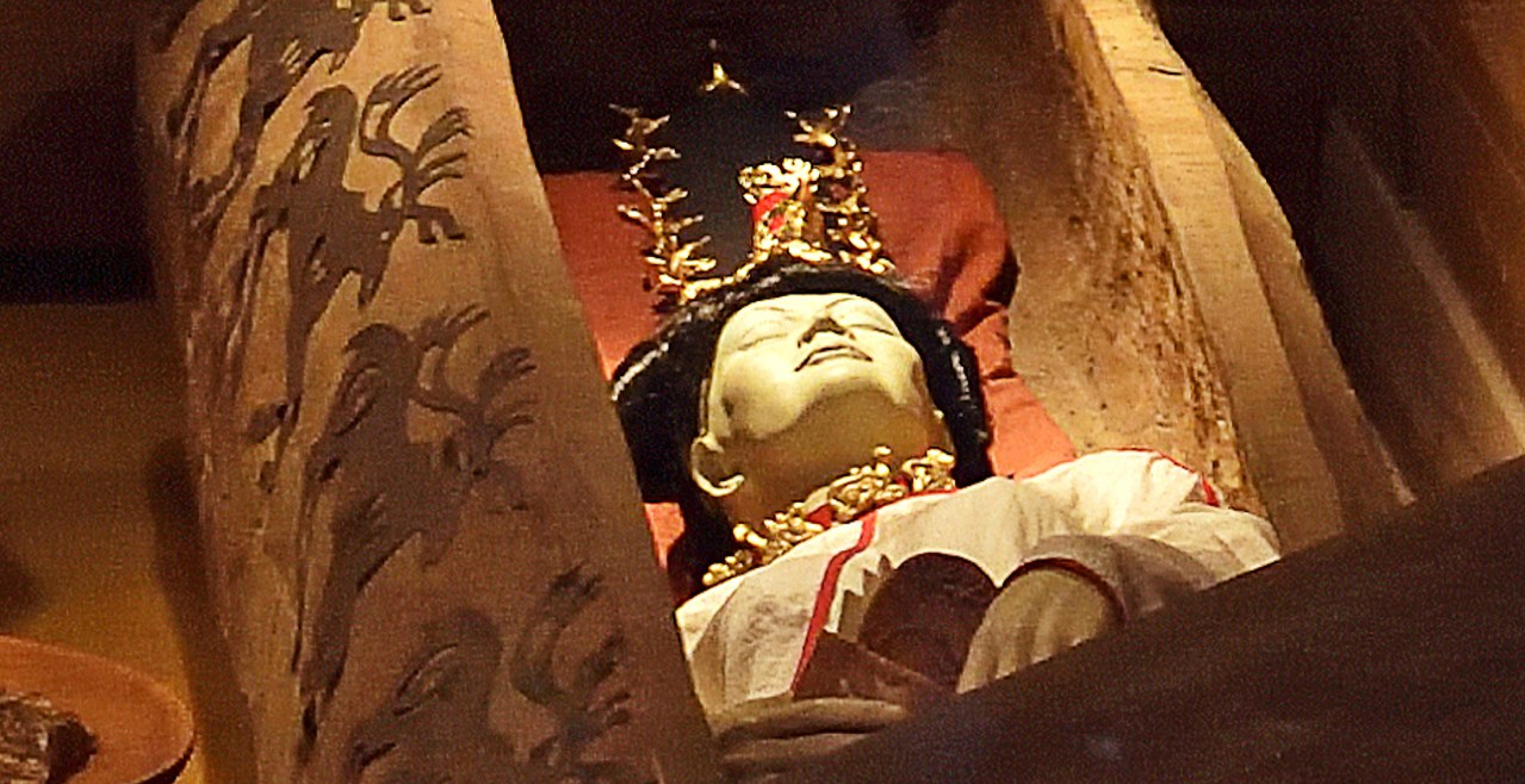
The Siberian Ice Maiden, also known as the Princess of Ukok and the Altai Princess, is a 2,500-year-old historical figure. This tattooed mummy was discovered in 1993 on the Ukok Plateau of the Altai Mountains by Russian archaeologist Natalia Polosmak and her team.

Image Credit: Daily Mail UK
Natalia Polosmak has spent most of her career specializing in the different nomadic groups that occupied the Altai Mountains during the early metal age (3200-2300 BCE). The ice maiden was Polosmak’s most significant discovery because she, along with the contents of her grave, and the ancient tattoos in her skin, were astoundingly well preserved by the permafrost that encased her body.

Image Credit: BBC Global via knewz.com
Cause of Death
Thought to have been in her mid twenties at the time of her death, the princess was revealed to have been suffering from breast cancer. Additional MRI scans also indicated that she had been born with a bone disease called osteomyelitis and had suffered an injury early in life, perhaps falling from horseback. Traces left behind would suggest that her illness was likely exacerbated by the ritualized inhalation of mercury and copper. Ultimately, breast cancer appears to be her official cause of death.

Image Credit: The Siberian Times via Daily Mail UK
Burial
Despite being labeled a “princess”, her burial was consistent with those belonging to a middle layer of Pazyryk society. It is believed that the process of her burial spanned over three months.
Her vital organs were removed and replaced with peat and moss, and the material goods recovered in her burial site were meticulously sourced and curated. Some of the objects buried with the ice maiden included garments such as a long, wide wool skirt, made from three horizontal strips of hand-dyed fabric. Archeologists also discovered a silk shirt deriving from Assam, India, a stylish, light fur coat, a felt cap, a wig headdress, and a stone saucer containing charred coriander seeds. She was outfitted with a “cosmetics bag” on her hip, which carried a facial brush made of horse hair, and a fragment from what could be compared to an eyeliner pencil, which was made from vivianite powder that would leave a deep blue/green color on the skin. The textiles used by the Pazyryk were not particularly convenient for the climate; not only were they not the warmest available option, but also not the toughest. These fabrics would easily wear out and need to be replaced, suggesting they dressed more for fashion than utility. The fusion of influences seen in her clothes, from Ancient Chinese, Iranian, and Mediterranean cultures, positions the Pazyryks among the earliest examples of synthesis between cultures of East and West.
The headwear found was a wig of sorts- it was to be placed on top of a shaved head, the base was a felt hat, and the hair sewn into the top of the wig was wrapped with woolen cord for it to stand upright. It is thought that wearing hair tall like this was a sign of status. The Ice Maiden’s headwear was topped with a bronze pin of a deer and a tall feather with 15 small birds attached to it. This tall feather is interpreted to signify the tree of life. The coffin made from a hollowed tree for her burial was specifically crafted to be long enough to accommodate this headdress. The Pazyryks would have spent a lot of time on horseback, so that means that the Ice Princess was wearing this extremely tall and extravagant headpiece while riding through the Altai region of Southern Siberia.

Image Credit: The Siberian Times via Daily Mail UK
In the same tomb where the Ice Maiden was found, Polosmak and her team also discovered six horses and a man buried among them. He is believed to have been a servant or slave. The horse that he was buried with had a battle ax wound to the head, and was so well preserved that it still had grass and pine needles in its stomach. Also in the tomb was a table possessing cannabis, a vase of liquid, and a large piece of horse meat with a knife sticking out of it. These objects were placed next to the ice maiden as a means of providing her with nourishment in the afterlife.
Was She a Healer?
Even though she is commonly referred to as 'princess', researchers believe that she may have actually been a shaman who gained an 'altered state of mind' through her use of cannabis, leading her kinsmen to believe that she had special powers. "Probably for this sick woman, sniffing cannabis was a forced necessity. And she was often in an altered state of mind," said Polosmak. "We can suggest that through her we could speak of the ancestral spirits and gods. Her ecstatic visions in all likelihood allowed her to be considered as some chosen being, necessary and crucial for the benefit of society. She can be seen as the darling of spirits and cherished until her last breath." (Spicer, 2014). The tattoos that adorn the skin of the Siberian ice maiden were located on her shoulder, wrist, and thumbs. The tattoo on her upper shoulder depicted a fantastical griffin-like creature, which was also found inked on the ancient, frozen remains of more than three dozen individuals excavated in the area. Pazyryk tattoos were part of a sacral ritual, granting knowledge and serving as a rite of passage. Since she had several tattoos, more than those buried around her, we can infer that she was thought to possess special knowledge.

Image Credit: Wikimedia Commons

Controversy
There was a campaign for her return to the Altai because the native people there had mythologized her, describing her as a “mystical keeper of the Altai”. Locals believed that disturbing her burial site and taking her body to Novisbirsk for archaeological testing was leading to the increased seismic activity in the area. Some even circulated a claim that a local shaman had spoken to the Princess and had been told by her that she wished to be returned home. These incidents, among others, led to a ban prohibiting Russian archaeologists from undertaking any more excavations of the sites along the Ukok Plateau and required that her body be returned to a museum in Gorno-Altaisk, which finally happened in 2012.
Interestingly, the Ice Maiden possessed more Caucasoid than Mongoloid facial features, and her genetic composition differs greatly from modern Altaians. This is a major point of contention in contemporary conversations about the ethics of repatriation.

Image Credit: Marcel Nyffenegger / The Siberian Times
Ice Maiden Meditations
There are several prescient topics to meditate on following an introduction to this extraordinary woman. The Ice Maiden may serve as a subject of examination to medical anthropologists studying cancer, disease, pain relief, disability, genetics etc. Culturally, she provides important context for the rites surrounding death and dying for the Pazyryks. Most of all, she leaves us with the important task of interrogating historical claims that subvert the role of women. Not only a woman, but a disabled woman, the Ice Maiden played an essential role and was greatly respected and revered in life and in death. Thus, we must assume that similar stories, buried by time, are only waiting to be unearthed. Onward.
Bibliography
Halemba, Agnieszka. “‘What Does It Feel like When Your Religion Moves under Your Feet?’ Religion, Earthquakes and National Unity in the Republic of Altai, Russian Federation.” Zeitschrift Für Ethnologie, vol. 133, no. 2, 2008, pp. 283–99. JSTOR, http://www.jstor.org/stable/25843151 Accessed 2 Dec. 2023.
Hays, Jeffrey. “Pazyryk: Their Queen, Burial Sites and Tattoos.” Facts and Details, https://factsanddetails.com/asian/cat65/sub422/entry-7113.html Accessed 4 Dec. 2023.
Manaev, Georgy. “The Mystery of the Siberian Ice Maiden.” Russia Beyond, 31 May 2021, www.rbth.com/history/333847-mystery-of-siberian-ice-maiden-ukok-plateau-princess
“Meet the 2500 Year Old Siberian Ice Maiden and Her Tattoos.” The Archaeologist, The Archaeologist, 13 Aug. 2023, www.thearchaeologist.org/blog/meet-the-2500-year-old-siberian-ice-maiden-and-her-tattoos
Readman, Kurt. “The Ice Maiden: Who Was the Frozen ‘Princess’ of Ukok?” Historic Mysteries , Historic Mysteries, 24 Nov. 2021, www.historicmysteries.com/princess-of-ukok/
“Siberian Ice Maiden.” Wikipedia, Wikimedia Foundation, 31 Oct. 2023, en.wikipedia.org/wiki/Siberian_Ice_Maiden
Spicer, K. (2014, October 16). Ancient siberian princess died from breast cancer and smoked cannabis to ease pain. International Business Times UK. https://www.ibtimes.co.uk/ancient-siberian-princess-died-breast-cancer-smoked-cannabis-ease-pain-1470366
less
Bio

Katy Oakley (she/her) is a recent Anthropology MA graduate from The New School for Social Research. Her thesis work covers the commodification and subsumption of marginalized ways of being/knowing. Currently, her research spans topics related to post-truth politics and altered states of consciousness.
Comment
Your message was sent successfully